
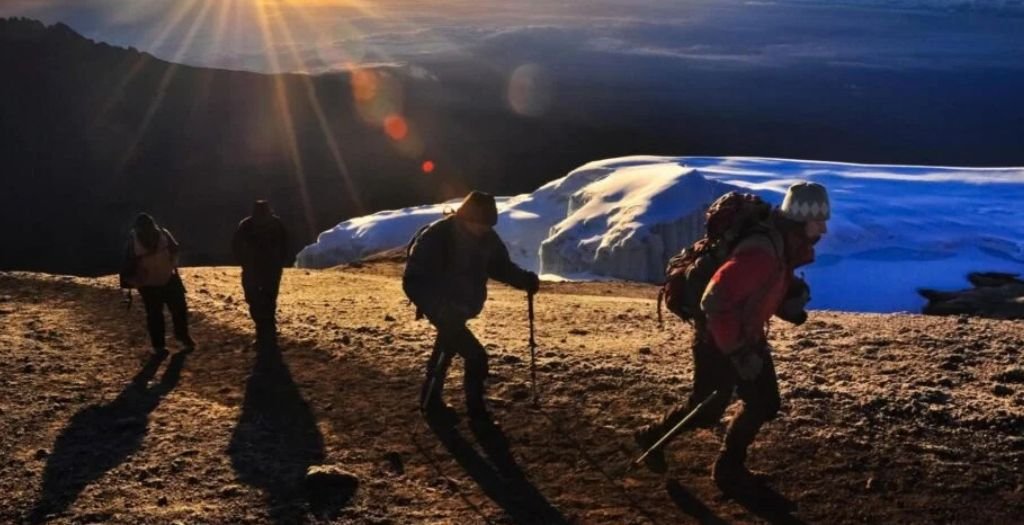
The 6-day Machame Route is one of the most popular shorter itineraries for climbing Mount Kilimanjaro. Known for its dramatic scenery, varied landscapes, and challenging terrain, the route takes you from the rainforest at Machame Gate through the Shira Plateau, Lava Tower, Barranco, and Barafu before reaching Uhuru Peak at 5,895 metres (19,341 feet).
The 6-day itinerary is demanding because it compresses the trek into fewer days than the 7-day Machame itinerary. In particular, the approach to Barafu and the summit push make the final part of the climb physically demanding. Some operators recommend the 7-day version because the additional day provides more time for acclimatization.
If you’re considering the 6-day Machame Route, here’s exactly what the trek looks like.
What Is the 6-Day Machame Route?
The Machame Route approaches Kilimanjaro from the southwestern side of the mountain and crosses several of Kilimanjaro’s ecological zones.
The trail begins in the rainforest before climbing through moorland and the Shira Plateau. From there, it crosses the alpine desert around Lava Tower and continues through Barranco and Karanga before reaching Barafu Camp, the launching point for the summit.
The descent takes a different trail through Mweka.
Unlike the Marangu Route, the Machame Route uses tented camps throughout the trek.
The standard 6-day itinerary is approximately:
| Day | Route | Hiking time |
|---|---|---|
| Day 1 | Machame Gate → Machame Camp | 5–7 hours |
| Day 2 | Machame Camp → Shira Camp | 4–6 hours |
| Day 3 | Shira → Lava Tower → Barranco | 6–8 hours |
| Day 4 | Barranco → Karanga → Barafu | 8–10 hours |
| Day 5 | Barafu → Uhuru Peak → Mweka | 12–15+ hours |
| Day 6 | Mweka → Mweka Gate | 3–4 hours |
Exact distances, camp names, hiking times, and elevations can vary slightly between operators and itineraries.
6-Day Machame Route Itinerary at a Glance
The route follows this general progression:
Machame Gate → Machame Camp → Shira Camp → Barranco Camp → Barafu Camp → Uhuru Peak → Mweka Camp → Mweka Gate
One important feature of the 6-day itinerary is that there is no overnight at Karanga Camp in the compressed version. The trek continues from Barranco through Karanga to Barafu in one long day before the summit attempt.
That makes the final stages more demanding than the 7-day version.
Day 1: Machame Gate to Machame Camp
Distance: Approximately 11 km
Hiking time: 5–7 hours
Starting elevation: Approximately 1,800 m
Camp elevation: Approximately 3,000 m
Habitat: Montane rainforest
Your Machame Route adventure begins at Machame Gate, where you complete the necessary registration and preparations before entering Kilimanjaro National Park.
The trail immediately enters the lush rainforest.
The first day is a steady uphill hike through dense vegetation, with tall trees, moss, ferns, and plenty of birdlife. Depending on the season, the trail can be wet and muddy.
After several hours of walking, you arrive at Machame Camp, where your mountain crew will have prepared the campsite.
This is your first night on the mountain.
What to expect: A relatively long but manageable first day, with humid conditions and a steady climb through the forest.
Day 2: Machame Camp to Shira Camp
Distance: Approximately 5 km
Hiking time: 4–6 hours
Starting elevation: Approximately 3,000 m
Camp elevation: Approximately 3,800–3,850 m
Habitat: Moorland
After leaving Machame Camp, the landscape changes dramatically.
The dense rainforest gradually gives way to heather and moorland as you climb higher.
The trail becomes steeper and rockier as you make your way toward the Shira Plateau.
The vegetation becomes more sparse, and you’ll begin to get increasingly impressive views of Kilimanjaro and the surrounding landscape.
Although this is a shorter hiking day than Day 1, you’re gaining considerable elevation.
You eventually arrive at Shira Camp, where you’ll spend the night.
What to expect: Cooler temperatures, changing vegetation, rocky terrain, and your first real experience of trekking at higher altitude.
Day 3: Shira Camp to Lava Tower to Barranco Camp
Distance: Approximately 10–14 km, depending on the itinerary
Hiking time: 6–8 hours
Highest point: Approximately 4,600 m at Lava Tower
Camp elevation: Approximately 3,900 m
Habitat: Alpine desert
Day 3 is one of the most important days of the Machame Route from an acclimatization perspective.
From Shira, you head east toward Lava Tower, climbing to approximately 4,600 metres.
You don’t spend the night at that elevation.
Instead, after reaching Lava Tower, you descend toward Barranco Camp at approximately 3,900 metres.
This creates the classic “climb high, sleep low” pattern.
The change in elevation can make this day feel more demanding than the previous days, but the route provides spectacular scenery as you move through the alpine desert.
By the time you reach Barranco Camp, you’ll be directly below the impressive Barranco Wall.
What to expect: A longer day, thinner air, significant elevation gain and loss, and some of the most dramatic scenery of the trek.
The Lava Tower section is an important part of the itinerary because it gives trekkers an opportunity to spend time at higher elevation before sleeping lower at Barranco.
Day 4: Barranco Camp to Karanga to Barafu Camp
Distance: Approximately 9–10 km
Hiking time: 8–10 hours
Starting elevation: Approximately 3,900 m
Barafu elevation: Approximately 4,600–4,700 m
Habitat: Alpine desert
Day 4 is where the 6-day Machame itinerary becomes particularly demanding.
The morning begins with the Barranco Wall.
Despite its imposing appearance, the Barranco Wall is a hiking and scrambling section rather than a technical rock-climbing route. Your guide will help you negotiate the steeper sections.
After reaching the top of the wall, the trail continues through the Karanga area.
On the 7-day Machame itinerary, trekkers normally spend the night at Karanga Camp.
On the compressed 6-day itinerary, however, you continue toward Barafu Camp.
That means a substantial amount of elevation gain and several hours of hiking before reaching the summit base camp.
Once you arrive at Barafu, you’ll eat, prepare your summit equipment, and try to rest.
You won’t have a normal night’s sleep.
The summit attempt usually begins around midnight.
What to expect: One of the longest days before the summit, with steep sections, increasing altitude, and very limited time to rest before summit day.
Day 5: Barafu Camp to Uhuru Peak to Mweka Camp
Hiking time: Approximately 12–15 hours or more
Summit elevation: 5,895 m
Starting elevation: Approximately 4,600–4,700 m
Destination: Mweka Camp
This is the biggest day of the trek.
You’ll usually wake around midnight, have a light meal or hot drink, put on your warm layers and headlamp, and begin the climb toward the summit.
The trail is steep and slow.
You’ll climb through the darkness toward Stella Point on the crater rim before continuing toward Uhuru Peak.
The final section can be particularly challenging because of the altitude.
Eventually, you’ll reach Uhuru Peak at 5,895 metres, the highest point on Mount Kilimanjaro and the highest point in Africa.
After spending some time at the summit, you’ll begin your descent.
You return toward Barafu before continuing down to Mweka Camp, where you’ll spend the night.
The summit day can involve approximately 12–15 hours or more of hiking, making it dramatically longer than a normal trekking day.
What to expect: An early start, cold temperatures, steep terrain, a slow pace, a long summit ascent, and an equally demanding descent.
Day 6: Mweka Camp to Mweka Gate
Distance: Approximately 10 km
Hiking time: 3–4 hours
Starting elevation: Approximately 3,000–3,100 m
Mweka Gate: Approximately 1,600–1,800 m
Habitat: Montane rainforest
After breakfast, you begin the final descent through the rainforest.
Compared with summit day, this is a much shorter and more relaxed day.
The trail gradually loses elevation as you make your way toward Mweka Gate.
Once you reach the gate, you’ll complete the necessary exit procedures and receive your summit certificate before transferring back to your hotel.
After several days on the mountain, this is usually the moment when the achievement of reaching Uhuru Peak really starts to sink in.
How Difficult Is the 6-Day Machame Route?
The 6-day Machame Route is a challenging Kilimanjaro itinerary.
The difficulty isn’t simply because you walk for several hours each day. The challenge comes from the combination of:
- Long hiking days
- Significant elevation gain
- High altitude
- Steep terrain
- Limited recovery time
- A demanding summit day
- Sleeping at altitude
- The compressed itinerary
The biggest difference between the 6-day and 7-day versions is the amount of time available to spread the trek out.
The 6-day itinerary combines the Barranco-to-Karanga section with the climb toward Barafu, creating a particularly long day before the summit attempt.
This is why the 6-day route is generally more appropriate for trekkers who are comfortable with long mountain days and understand the demands of high-altitude trekking.
What to Expect on the 6-Day Machame Route
1. You will hike slowly
Don’t expect to walk at the same pace you would on a normal hiking trail.
The pace becomes deliberately slow as you gain altitude.
Your guide will generally control the pace of the group and allow regular breaks.
2. The scenery changes constantly
One of the major attractions of Machame is the variety of landscapes.
You’ll move through:
Rainforest → Moorland → Shira Plateau → Alpine Desert → Arctic Zone
That means the environment can look dramatically different from one day to the next.
3. You’ll sleep in tents
Unlike Marangu, the Machame Route uses tented camps.
Your trekking crew normally establishes the campsite while you hike, so your tent can be ready when you arrive.
4. Summit night is cold
Temperatures can drop significantly around the summit.
You’ll want appropriate warm layers, gloves, a hat, and other cold-weather equipment.
Your complete packing list should account for both the hot, humid conditions in the lower forest and the cold conditions near the summit.
5. The summit day is extremely long
This is probably the biggest thing to understand before choosing the 6-day itinerary.
You may start climbing around midnight and continue hiking for many hours before reaching Mweka Camp after the summit.
The ascent and descent together can make summit day substantially longer than every other day of the trek.
6-Day vs 7-Day Machame Route
The main difference between the two itineraries is the additional day.
On the 6-day Machame Route, the trek is compressed.
On the 7-day Machame Route, the itinerary generally includes an overnight at Karanga Camp before continuing to Barafu.
This means the 7-day version spreads the trek over an additional day.
| Feature | 6-Day Machame | 7-Day Machame |
|---|---|---|
| Duration | 6 days | 7 days |
| Accommodation | Camping | Camping |
| Route | Machame | Machame |
| Summit | Included | Included |
| Karanga overnight | Usually omitted | Included |
| Pace | More compressed | More gradual |
| Recovery time | Less | More |
| Difficulty | More demanding | Less compressed |
Some operators specifically recommend the 7-day version because the extra day provides more time for acclimatization.
If you have enough time, it’s worth comparing both itineraries rather than assuming that the 6-day version is automatically the better choice simply because it is shorter.
Who Is the 6-Day Machame Route Best For?
The 6-day Machame Route may suit trekkers who:
- Have good physical fitness
- Are comfortable with long hiking days
- Have previous trekking experience
- Have limited time for their Kilimanjaro climb
- Understand the demands of altitude
- Are prepared for a particularly demanding summit day
It isn’t necessary to be an elite athlete to climb Kilimanjaro, but you should take the physical demands seriously.
Training for long uphill and downhill walks before your trip can help you prepare for the daily demands.
If you’re unsure about the physical requirements, see our guide:
Climbing Kilimanjaro: Difficulty, How Hard Is It Really?
What Should You Pack for the 6-Day Machame Route?
Because Machame involves camping and a wide range of elevations, your packing list needs to cover very different conditions.
Important items include:
- Waterproof hiking boots
- Hiking socks
- Waterproof jacket and trousers
- Warm fleece or insulated jacket
- Base layers
- Warm hat and gloves
- Sun hat
- Sunglasses
- Headlamp
- Trekking poles
- Water bottles or hydration system
- Sleeping bag suitable for cold temperatures
- Daypack
- Sunscreen
- Personal medications
- Snacks
For the complete equipment checklist, see:
Kilimanjaro Packing List: Essential Gear for a Safe & Comfortable Climb
Frequently Asked Questions
How many days is the Machame Route?
The Machame Route can be completed in 6 or 7 days, with longer itineraries also possible. The 6-day version is more compressed, while the 7-day version spreads the trek over an additional day.
How many hours do you hike each day on the 6-day Machame Route?
Most trekking days take approximately 4–10 hours, depending on the day. Summit day is much longer and can involve around 12–15 hours or more of hiking.
Is the 6-day Machame Route difficult?
Yes. It is a challenging itinerary because the trek is compressed and includes long days before and during the summit attempt.
Is 6 days enough to climb Kilimanjaro via Machame?
A 6-day Machame climb is a standard itinerary and is possible, but it provides less time for acclimatization than the 7-day version.
What is the nickname for the Machame Route?
The Machame Route is commonly known as the Whiskey Route, while Marangu is often called the Coca-Cola Route.
Does the Machame Route use tents?
Yes. The Machame Route is a camping route, with trekkers staying in tents rather than the mountain huts used on Marangu.
Where does the Machame Route start?
The route starts at Machame Gate, on the southern/southwestern side of Mount Kilimanjaro.
Where does the Machame Route finish?
After reaching Uhuru Peak, the descent generally follows the Mweka Route, finishing at Mweka Gate.
Conclusion
The 6-day Machame Route is a scenic but demanding way to climb Mount Kilimanjaro.
You’ll travel from the rainforest at Machame Gate through the Shira Plateau and Lava Tower before crossing Barranco and climbing toward Barafu. The trek culminates with a midnight summit attempt to Uhuru Peak, followed by a long descent to Mweka Camp.
The biggest thing to understand is that six days makes the itinerary more compressed. The day from Barranco toward Barafu is long, and summit day can involve 12–15 hours or more of hiking.
If you’re fit, prepared for long trekking days, and have limited time, the 6-day itinerary can be an option. If you have an extra day available, however, the 7-day Machame itinerary provides a less compressed schedule and additional time for acclimatization.
For those specifically researching the duration of a Kilimanjaro climb, you can also read our guide to How Long It Takes to Climb Kilimanjaro.